Review: Our Dignity Can Defeat Anyone
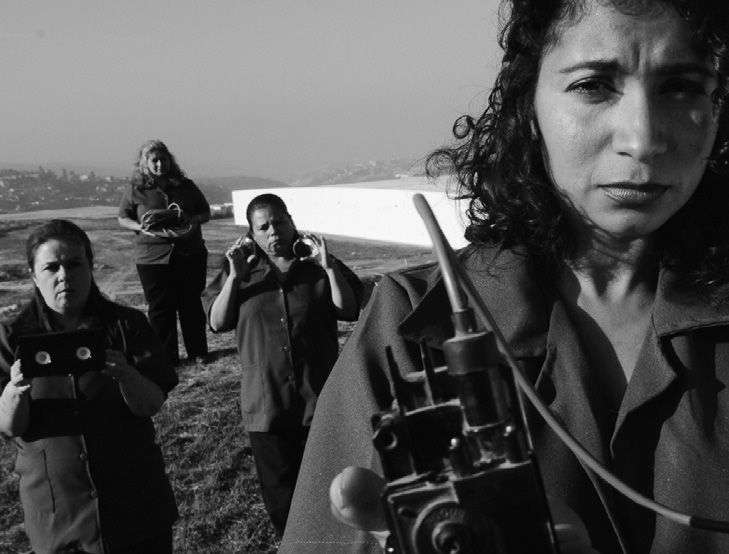
Maquilapolis [City of Factories]
A film by Vicky Funari and Sergio De La Torre
2006, 68 min.
California Newsreel
Available from Teaching for Change
(www.teachingforchange.org) $50.
Push, assemble, remove, push, assemble, remove. A line of women are dressed alike in blue smocks that indicate their respective positions in one of Tijuana, Mexico’s 4,000 factories. They are the manufacturing “machines” corporations so desire in the global economy. Silently, they push, assemble, remove, push, assemble, remove.
But as the film continues, the power of Maquilapolis, (City of Factories) is evident—the women come alive, sharing their dilemmas, resistance, and hope. The film follows two former maquiladora workers, Lourdes Lujan and Carmen Duran, as they take on the multinational corporations harming their community and infringing on workers’ rights. The women are promotoras, members of a social justice group organized to educate and empower the thousands of Tijuana maquiladora workers.
Tijuana has a long history of multinational corporations exploiting Mexican women. As the film’s narrator explains: “They said we would make a good workforce because we had agile hands and would be cheap and docile.” A 1960s treaty between the United States and Mexico created some of the first assembly centers and then this model—imported U.S. goods, assembled in Mexico and then exported back to the United States and the world—exploded in 1994 as a result of the North American Free Trade Agreement, NAFTA.
We watched Maquilapolis in my 11th-grade global studies class at Franklin High School in Portland, Ore., as part of a larger unit on Mexico and the history and current issues impacting the border, based on the Rethinking Schools book The Line Between Us: Teaching About the Border and Mexican Immigration. Although a subtitled film—”You mean we have to read while we watch?”—students were totally engrossed. Maquilapolis, in its video diary style, allowed students to travel to Tijuana with Lourdes and Carmen. Many of my students have not traveled any farther south than our state capital, Salem, just an hour down I-5 from Portland, because their own families struggle to make ends meet; but this film allowed them an intimate view of the women’s lives: their neighborhoods, their factories, their homes, watching their children play. Lourdes and Carmen brought the border—and issues of toxic contamination, workers’ rights, and resistance—alive for my students. It was “real” in a way that brought an abstract concept like “Free Trade,” to ground level. They could see and hear the sizzle of the electric wires where residents had tapped into the main lines, laughed in recognition at the scrappy neighborhood dogs, groaned with want as plates of food passed across the screen.
To engage students further, we completed a “found poem” using the film’s powerful language. A found poem is a way for students to work creatively with a film’s content—for them to deal with emotions, characters, or critical issues in a film or reading that doesn’t feel like “note-taking.” Text—in this case subtitles—are key to this activity. As students watch the film, they select words or phrases that stand out, creating a list of these snippets of text to come back to after the film is over. My “Get out a piece of paper,” was met with the standard, “Can’t we just watch a film in this class?” But as I explained the assignment, students’ creative impulses kicked in. “As you watch the film, you are going to create a list. This list can be words or phrases, anything that catches your ear, seems rich, powerful, full of potential. This list can be as messy or cryptic as it needs to be so you have material to work with afterwards when we’re going to use it to make a found poem.” For homework, students took those lists and manipulated them to create a poem that expressed one of the following choices: how they felt about what they saw, how a character in the film may feel about her life and the impact of the maquliadoras, or a response to any issue raised by the film. “Think of the tools you have in poetry,” I said to the students as they were packing up their bags at the end of class, “use spacing, repetition; you can manipulate your list anyway you need to in order to make your poem.”
One of the results of the maquiladora system is its blatant disregard for the lives of workers and the land where they and their families live. Students were shocked to see a river running full of the effluence of industrial production—at flood stage, even though it had just started raining. Taking advantage of Mexico’s less rigorous environmental standards and lax enforcement, multinational companies were spilling waste-water into the Río Alamar, a river that cuts through Lourdes Lujan’s neighborhood of Chilpancingo. “DON’T TOUCH IT!” Korissa yelled to the child on the screen who ventured too close to the toxic brew. It’s not just the water, it is also the very air the workers breathe, both in the factory—full of adhesives and solvents attacking the respiratory, nervous, and reproductive systems—and in their community, as 8,500 tons of lead, arsenic, cadmium, and other carcinogens become airborne every time the wind blows. It is this deadly slag, the refuse of the maquiladoras and specifically the now-abandoned, U.S.-owned Metales y Derivados, a “lead recovery” plant, which Lourdes is fighting with the organization she works with—the Colectivo Chilpancingo Pro Justicia Ambiental [Chilpancingo Collective for Environmental Justice], an affiliate of the cross-border Environmental Health Coalition. Tatyana wrote from Lourdes’ perspective in her poem.
When I was a kid, it was clean.
The air was fresh and crops grew healthy.
Now, it’s black, red, foamy.
Toxins evaporate and enter my lungs.
A very sad reality.
For what purpose? . . .-Tatyana Voronina
11th grade, Franklin High School
The desperate economic conditions in southern Mexico and the opportunity for jobs at the border and in the United States, draw thousands of workers to regions like Tijuana. Most of these women migrants are young, many are single parents and according to one promotora, Delfina Rodriguez, “all of them are ignorant” about their rights as workers and women under Mexican law. Carmen Duran was one of these women when, as a 13-year-old, she arrived in Tijuana—then known as “The World’s Capital of the Television.” She started working for Sanyo because it was close to her house; she stayed, she said, “because I am hard-headed,” even though after she left work, her nose bled and her clothes reeked from the adhesives used to produce a component called a flyback. For a low-skilled Mexican worker, maquiladora jobs pay relatively well, about $11 a day. Too well, it seems, because corporate leaders moved her job to Indonesia where labor costs were much cheaper. As another promotora said, “They leave with their hands full; ours are empty.” In Mexico, companies are required to pay severance wages before leaving; by this time, Carmen knew her rights and along with some co-workers, filed a labor claim against Sanyo. Jerram wrote from Carmen’s story.
. . . I work for Sanyo
AKA the one that doesn’t pay my severance
AKA the reason I have these spots
AKA the one that changes the color of the water
AKA maquiladora-Jerram Harte
11th grade, Franklin High School
For many of my students, their first response to the situations presented on the screen was, “Leave!” After seeing the mistreatment of workers and the environmental damage the maquilas create, students definitely felt more empathy for those individuals making the choice to cross the Mexico-U.S. border without documents. But Lourdes and Carmen do not intend to leave; nor do they intend to be the “cheap and docile” workers the maquiladoras so desire. Lourdes and Carmen are promotoras; as the narration of the film explains: “through knowledge, [we] see things differently, clear new paths, make changes in our daily lives, our communities, in our workplaces, and in ourselves.” Their resistance became a theme in the class writings, with the language they used to describe their struggle finding its way into virtually every poem.
. . . We must:
Set the precedent in opposition
Change everything
Demand an answer . . .-Trevor Zinzer
11th grade, Franklin High School
Lourdes, as part of the Colectivo Chilpancingo Pro Justicia Ambiental, demanded that those responsible for the Metales y Derivados site, including PROFEPA, the Mexican Federal Environmental Protection Agency and the U.S. Environmental Protection Agency (EPA), clean up the site. In 2004, after a 10-year struggle and international media attention, a binational accord was signed to clean up the site from start to finish, with the EPA pledging $85,000 to begin cleanup. Lourdes was triumphant: “Imagine, five women making a government official tremble!” As Jaime Cota, a workers’ rights advocate said, “Your dignity can defeat anyone.”
These are not just empty words. Lourdes and Carmen, through patient and consistent pressure, took on the likes of Metales y Derivados and Sanyo—and won. “It’s like David and Goliath,” Carmen observed. “See, you’re David and we’re fighting Goliath, this world famous company.” Sanyo saw the severance case as precedent-setting, and offered each woman $860 to end their case; the average labor arbitration board settlement is just $300 to $400. Carmen and her co-workers refused the company’s offer and pressed their case, ultimately receiving severance payments of $2,500 for Carmen and $2,000 for her co-workers.
As part of a larger unit on Mexico and the border, the film brings to life the impact of U.S. trade policy, intimately involving us in the lives of Lourdes and Carmen. The film highlights the abysmal conditions these women endure as maquiladora workers and the impact of these factories on their communities. But more importantly, it demonstrates that people working collectively have power and do make a difference; and that we, both citizens of Mexico and the United States, have a responsibility to challenge economic arrangements that benefit a small minority at the expense of workers.
All We Are Is More Than That
Tax breaks and cheap labor
that’s all we are
They’re making us sick
Red, black, green, and foamy water
Our poor kids suffer, we suffer
but they don’t see us as people
all we do is push, remove, push, remove
objects . . . machines, that’s what we are
Labor laws?
They’re screwing us
$68 a week
harassed every second of every day
harassed by the bosses’ cold hands at work
harassed by the look in my sick child’s eyes at home
for what?
$68 a week
I am determined to stand up to them
I am determined to be seen as more than a machine-Erin Chinn
11th grade, Franklin High School
Deciding to Stay
I saw the river change colors
But I decided to stay
Fertile soil for sowing factories
But I decided to stayYou breathe lead everyday
The wind and rain blow it down our street
What we’ll be exposed to-
But I decided to stay
Just remember that pointWe see things differently
You sow the seeds of what you have learned
You can’t stay quiet anymore
Your dignity can defeat anybodyI push, remove
And I’m wondering how everyone is doing
At home
Where I decided to stayThey depart with their hands full
Leave us with our hands empty
Harassed and pressured
We are cheap and docile
And still they want to pay us less and make more
The water used to be crystallineThis is why I decided to stay
Just remember this point
“Your dignity can defeat anybody”
and I struggle to breathe
Only the words remain,
Floating in the air.-Aria Joughin
11th grade, Franklin High School