No Comment 15.1
This content is restricted to subscribers
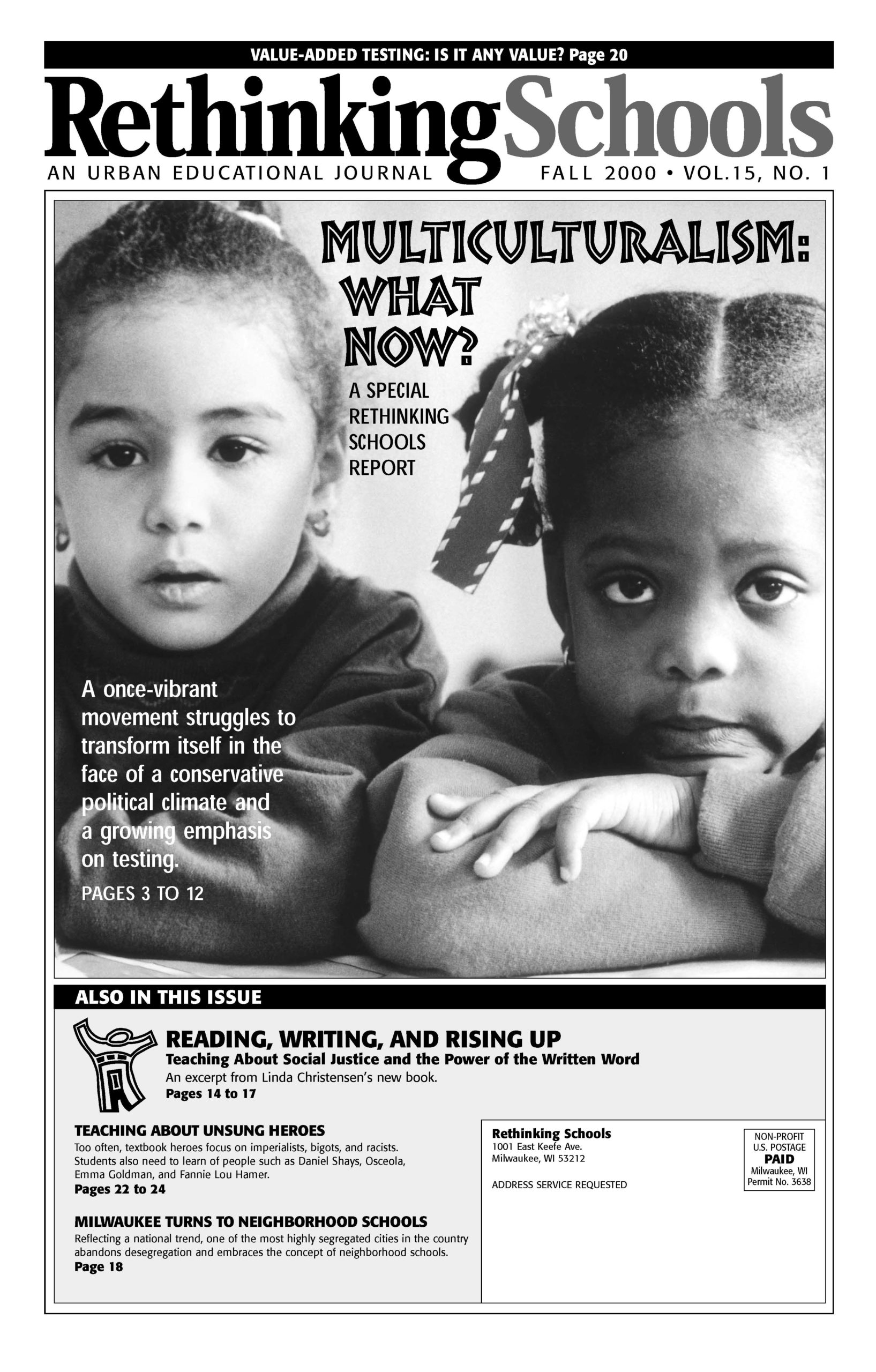
About the Special Report
Perspective The introductory article for our special report on multiculturalism.
Down But Not Out
White enthusiasm for multicultural, anti-racist education has waned, proponents faith in the movement's ability to endure and grow.
While enthusiasm for multiculturalism has waned, proponents have faith in the movement’s ability to endure.
Milwaukee: Will Top-Down or Community-Based Reform Prevail?
Tides of change are sweeping through MPS — including a threatened state takeover — but will state politicians or the local community direct future reform efforts?
Milwaukee: Who Won and Why
The school board elections garnered national attention as a vote on vouchers. But in the end, the results had more to do with issues of race and power, and poor campaign decisions.
The city’s school board election was portrayed nationally as a vote on vouchers. But the race was really about race and power, and how bad decisions can doom a campaign.
Embracing Cross-Racial Dialogue
“Some people say there is too much talk about race and racism in the United States
At Best, Silly, At Worst, Racist
The Massachusetts 10th-grade world history test is a Eurocentric exercise in travel pursuit.
The Massachusetts 10th-grade world history test is a Eurocentric exercise in trivial pursuit.
Pencils Out!
Here's a chance to see what's on the 10th-grade history and social sciences test in Massachusetts.
What’s on the 10th-grade test in Massachusetts?
Origins of Multiculturalism
Too many white educators think multiculturalism ends with ethnic food festivals. Here’s why multiculturalism needs to be placed in the context of the Civil Rights struggle for freedom, political power, and economic integration.
Rethinking Schools
Editorial It’s been 15 years since a group of activist teachers started Rethinking Schools, using only a temperamental Apple IIe and a kitchen table that stood in for a layout board. Some thoughts on how we’ve evolved since that humble beginning, and how we’ve stayed the same.
Creating A Vision of Possibility
How student writing can nurture reflection and hope.
An excerpt from her new book, Reading, Writing, and Rising Up: Teaching About Social Justice and the Power of the Written Word.
Saxophone
Student writing from Reading, Writing, and Rising Up.
Forward to the Past?
Issues of segregation, insufficient funding, and hurried decision-making envelop Milwaukee's proposal to return to neighborhood schools.
Issues of segregation, insufficient funding, and hurried decision-making envelop Milwaukee’s return to neighborhood schools
Controversial Testing Plan Goes to Milwaukee School Board
Controversy swirls around plan to increase standardized testing.
Value Added, Value Lost?
Value-added testing is enjoying increased popularity. But will this new approach help children learn better?
Value-added testing is enjoying growing popularity. Will it help children learn better?
Tax Dollars at Work
Georgia officers travel to Vermont to grill anti-testing advocate.
Georgia officers travel to Vermont to grill anti-testing advocate.
Unsung Heroes
Why aren't people such as Daniel Shays, John Ross, or Fannie Lou Hamer held up as role models?
Why aren’t people such as Daniel Shays or Fannie Lou Hamer held up as role models?
Teaching Unsung Heroes
How might a teacher encourage students to appreciate those who fought for social justice?
A list of first-person roles that students can play, as described in Bill Bigelow’s article .
Racial/Gender Justice Project
A list of first-person roles that students can play, as described in Bill Bigelow’s article .